What Is the AI Rap Duo Trend? The Hotel Lobby Meme Explained
Confused by the AI rap duo trend? Learn where the Hotel Lobby AI meme came from, how the two-photo format works, and how to join it responsibly.
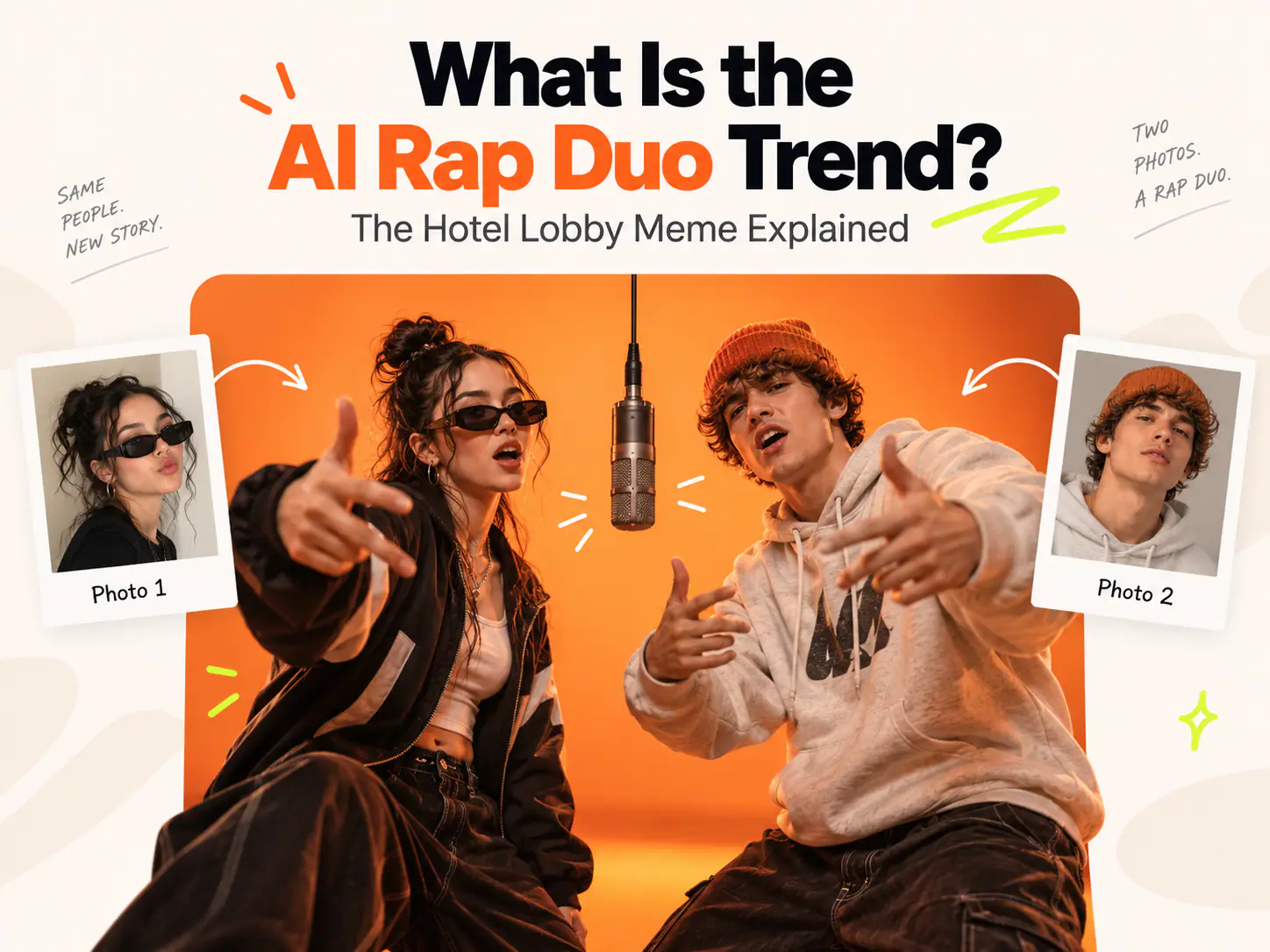
A short video keeps appearing on your feed: two people in an orange studio, one microphone between them, trading verses with the confidence of a rehearsal that has been happening for years. Then the joke lands. The performers are two cats. Or a fictional duo. Or your friends from school.
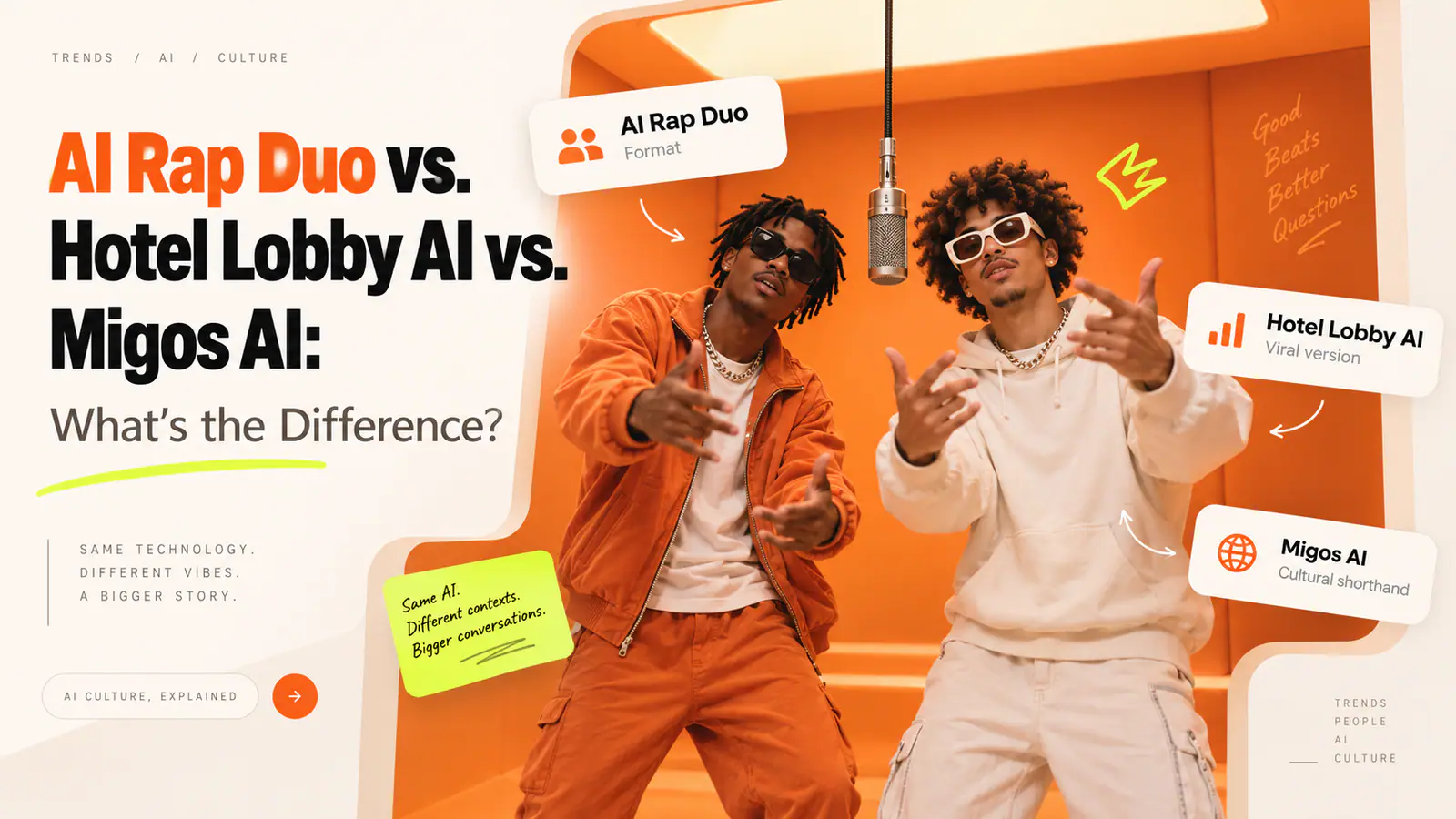
That is the AI rap duo trend—also called the Hotel Lobby AI trend, rap duo AI, or simply the two-photo rap meme. It is easy to mistake for a new AI song generator. It is not. The version now circulating is a tightly constrained visual remix: two portraits are placed into a recognizable two-person performance template, while the staging, movement, timing, and usually the familiar audio remain the point of reference.
This guide explains where the format came from, what the AI is actually changing, why the template works so well, and how to make a version without losing the context—or the common sense—that makes a meme shareable.
Quick answer: what is the AI rap duo trend?
The AI rap duo trend is a social-video format that turns two uploaded portraits into the apparent performers in a preset rap clip. In the Hotel Lobby version, the look comes from Quavo and Takeoff’s orange-set performance of “HOTEL LOBBY (Unc & Phew).” Rather than writing a new song, the trend usually swaps or synthesizes who appears to be performing in a familiar duet structure.
The simplest way to understand it: two faces change; the performance language does not.
That distinction matters. The appeal is not merely that an AI can animate a face. The appeal is that viewers recognize a strict visual grammar almost immediately: one person on the left, one on the right, a shared microphone, a bold orange background, rapid back-and-forth energy, and a short vertical-video payoff.
The original “Hotel Lobby” reference
The meme points back to the original A COLORS SHOW performance by Quavo and Takeoff, who performed as Unc & Phew. The song arrived in 2022, and the stripped-back performance gave the internet a rare thing: a scene simple enough to identify in one frame, but specific enough to feel like a complete world.
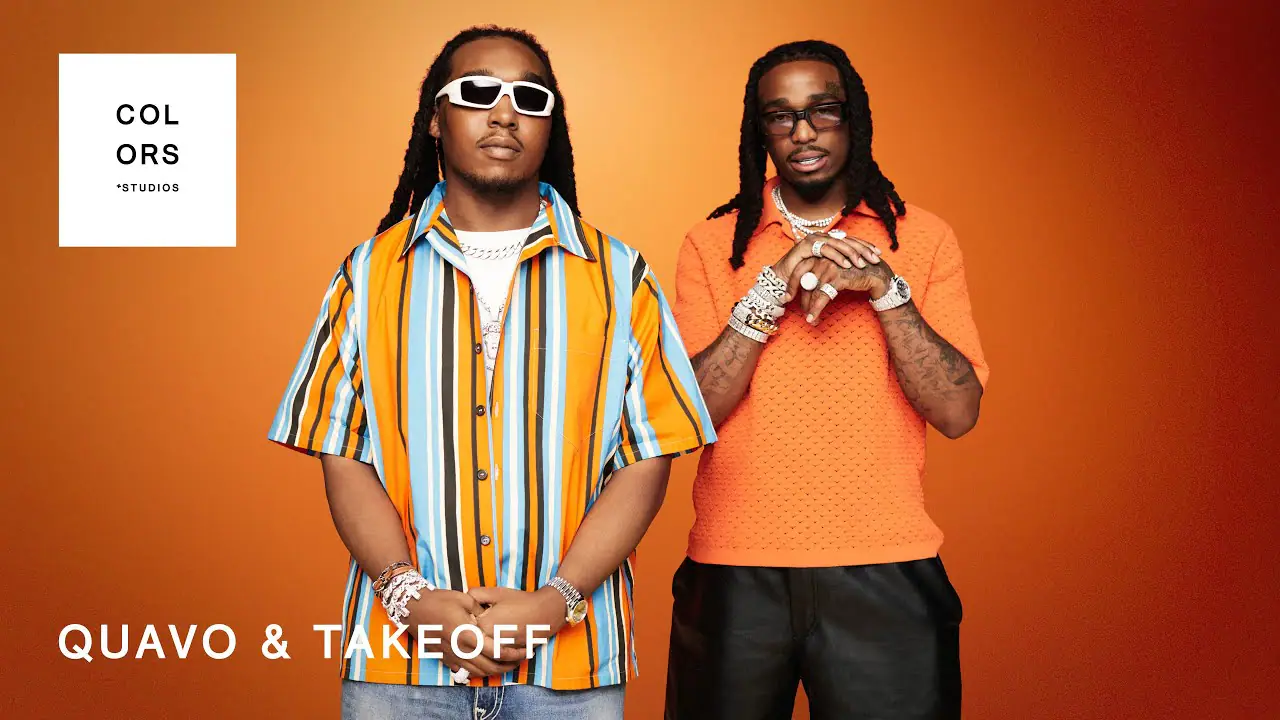
The orange backdrop, one hanging mic, and two-person staging are not incidental details. They are the visual shorthand that lets a viewer understand a remake before the first verse is over.
The current wave did not originate as a brand-new composition. As recent reporting on the trend explains, creators began reworking this performance with pairs ranging from animals and fictional characters to celebrities and sports figures. That is why “Hotel Lobby AI” is more accurate than “AI rap song” when you are talking about this particular meme.
What the AI changes—and what it usually leaves alone
The trend is clearer when you separate the template from the inputs.
| Element | Usually supplied by the template | Usually supplied by the creator |
|---|---|---|
| Performance setting | The orange studio, microphone, framing, and overall visual language | Nothing—the template establishes the scene |
| Performer positions | A left slot and a right slot, following the original two-person setup | Which portrait is assigned to each side |
| Movement and timing | Camera movement, gestures, lip-sync rhythm, and clip structure | Nothing, unless a tool offers limited variations |
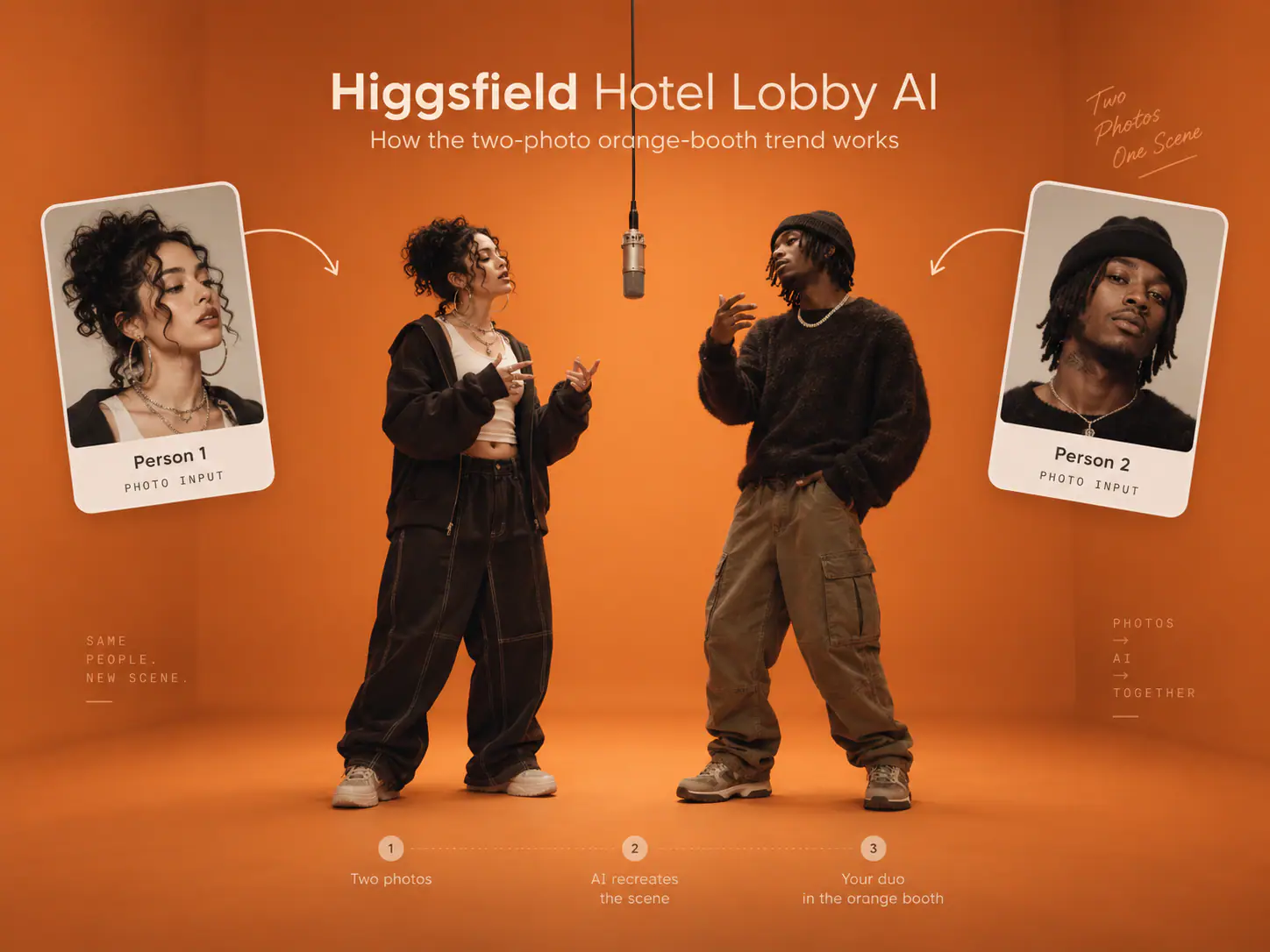
| Faces and pairing | The system maps or generates the visible performers | Two portrait photos and the joke behind the pairing |
| Audio | The reference track or a preset audio treatment, depending on the tool | Often no custom audio at all |
This is why the format feels more polished than a one-frame face swap. It has to preserve an illusion across motion: turns of the head, shoulders, hands, timing, and a camera that keeps moving. The output can still drift—features can blend, faces can soften, or the left/right identity can become unclear—but the template gives the model a much narrower job than “make a music video from scratch.”
It also explains why a good result depends less on writing a clever prompt and more on choosing usable images. In a preset trend, the input photos are the creative direction.
Why this rap duo trend spread so quickly
Most viral templates offer one of two things: a reusable sound or a reusable visual. Hotel Lobby AI combines both, then adds a third ingredient: a built-in relationship structure. Two people are already doing something together.
Here is what makes that unusually effective.
1. The format is instantly legible
A viewer does not need a caption to recognize the premise. Two performers share a mic in a saturated orange studio. Even people who do not know the original song can see that this is a stylized performance, not a random AI clip.
2. The pairing carries the joke
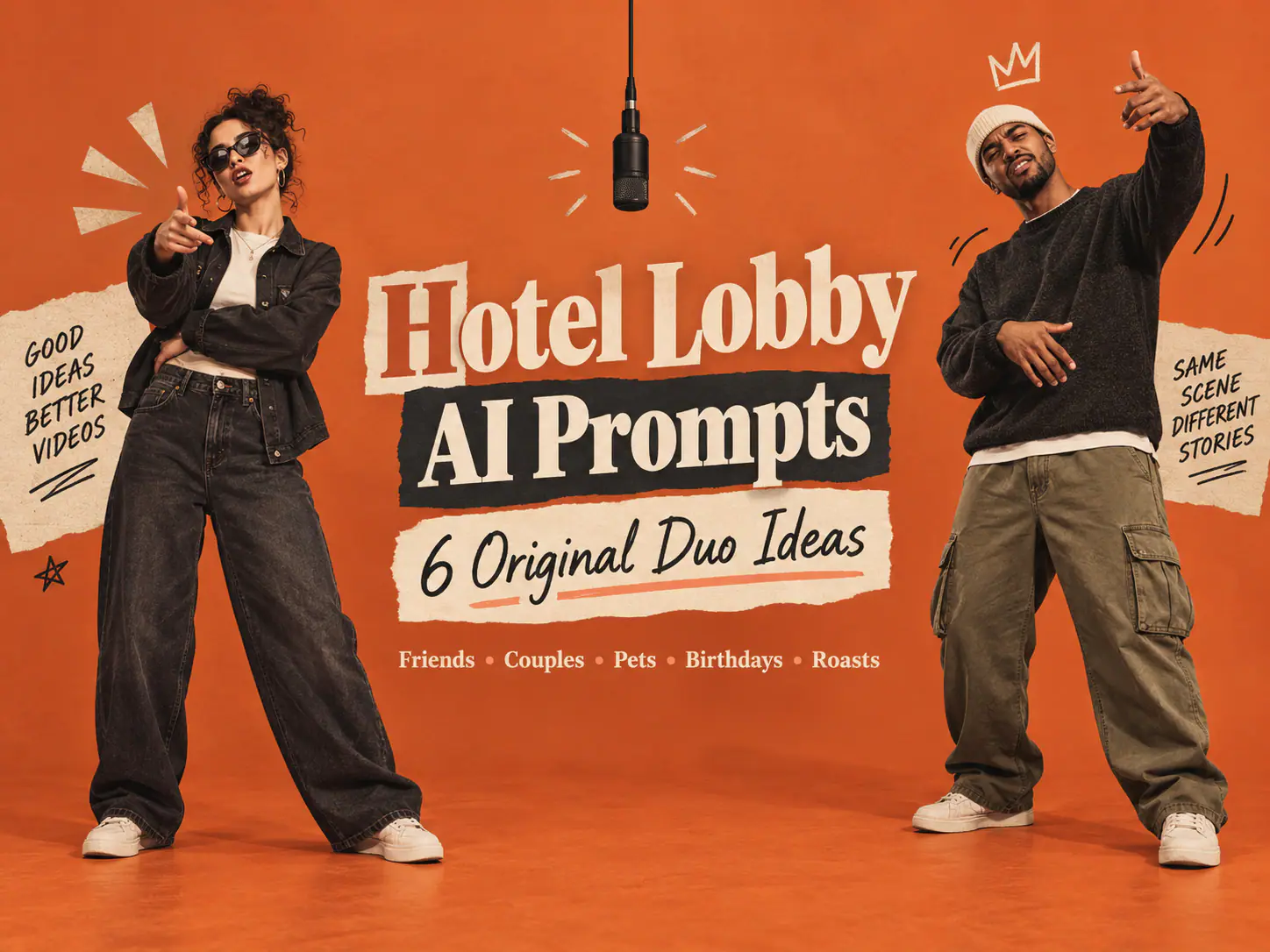
The strongest versions are rarely “two attractive faces.” They are pairs that need no explanation: siblings with opposite personalities, two friends behind an inside joke, a birthday person and their best friend, a serious colleague paired with the office comedian, or two fictional characters who clearly do not belong in the same studio.
The visual replacement is the mechanism. The relationship between the two subjects is the punchline.
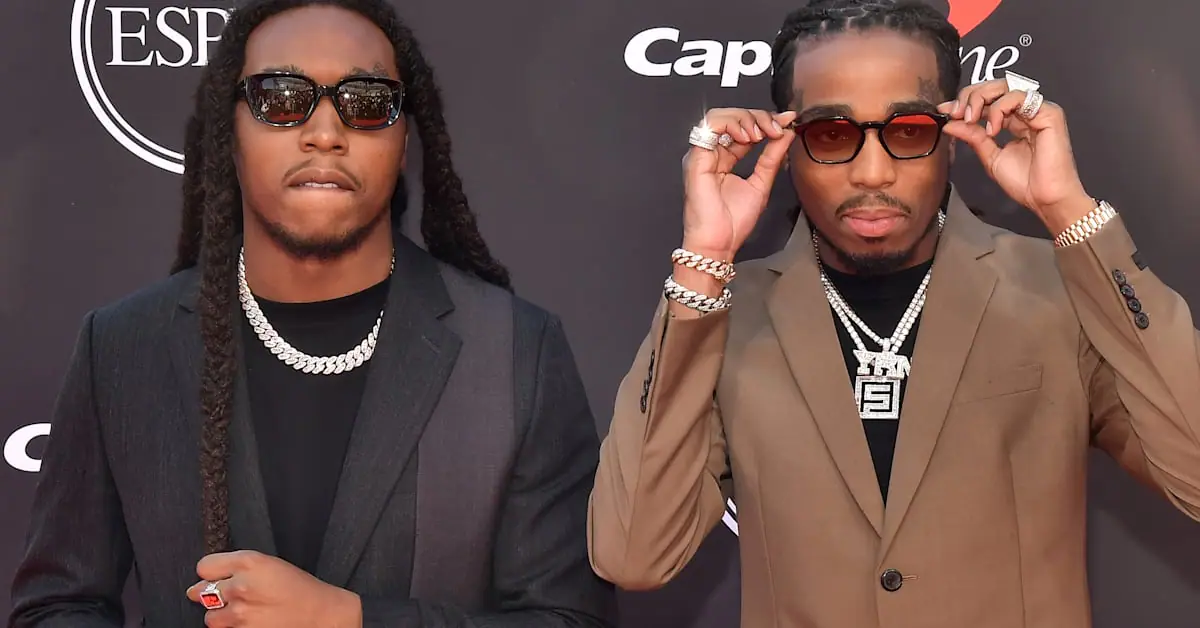
The best remakes preserve enough of the original staging that the new duo feels surprising rather than confusing.
3. The creator has very few decisions to make
A blank text-to-video tool can be powerful, but it asks for choices about a scene, action, camera, pacing, characters, and sound. This meme collapses that list to a few decisions: who is in it, who goes on which side, and what the pairing means. Low decision load is a major reason templates travel.
4. It is built for a vertical social loop
The result already has the rhythm of a Reel, TikTok, or group-chat clip. There is no need to explain the set, edit a cold open, or build to a reveal. A recognizable frame plus an improbable pair is enough.
How to make a version that actually works
You do not need to reproduce the original production process to join the format. You do need to respect the two-person premise.
Step 1: Start with the pairing, not the photo
Ask one question: Why these two?
A joke, contrast, friendship, birthday, team dynamic, or shared reference gives the video a reason to exist. If the answer is only “these were the two photos I had,” the output may look technically fine and still feel disposable.
Good starting prompts for yourself include:
- The quiet friend and the loud friend
- The birthday person and the person who always tells the story
- Two teammates after a win
- A before-and-after version of the same person
- A fictional pairing that makes the verse absurd in a useful way
Step 2: Use two clean, separate portraits
Use one person per image. Give each face enough visual information to survive movement.
Photo checklist
- Face the camera or use a clear three-quarter angle.
- Keep the face well lit and unobstructed.
- Choose a sharp photo with visible facial features.
- Avoid sunglasses, hands over the face, heavy beauty filters, or a crowded background.
- Do not use a group shot and expect the tool to guess the subject.
- Make sure you have permission from each person shown.
This is not busywork. If the source image is ambiguous, the video has to guess what “the person” is supposed to look like once motion begins.
Step 3: Decide left and right before uploading
The original setup gives each performer a side. Treat that as part of the joke. Put the more immediately recognizable face where you want the viewer to look first, or preserve the real-world order of a duo if that is the point.
Then watch the entire output—not just the opening frame. Look for face drift, swapped identities, awkward hand movement, disappearing shoulders, or audio that no longer matches the scene’s timing.
Step 4: Use a guided template when you want fewer controls
For people who want the two-photo premise without building a scene prompt or writing lyrics, AI Rap Duo is designed around this exact workflow: upload separate portraits, place the first person on the left and the second on the right, then generate a short vertical performance with a built-in scene and movement. It is most natural for friend pairs, birthday clips, inside jokes, and playful long-distance duos—not for creators who need to author custom lyrics or edit a custom soundtrack inside the same workflow.
That trade-off is useful. A fixed performance gives you a faster, more coherent result; an open-ended video workflow gives you more control but more chances to make a weak creative decision.
The responsible version: four checks before you post
The trend may look lightweight, but it combines personal images, a recognizable performance, and sometimes the likeness of public figures or deceased artists. “It is just a meme” is not a complete rulebook.
Get consent for the people in your photos
Use your own portrait, or ask the person pictured before you upload or publish a clip. This is especially important for embarrassing pairings, professional colleagues, children, or images pulled from private accounts. A funny surprise in a group chat can become a very different thing when it is posted publicly.
Do not present an AI clip as a real performance or endorsement
A face-mapped clip can be funny because it is implausible. It becomes risky when the joke depends on viewers believing that a real person performed, approved, sponsored, or said something they did not. Context and captions matter.
Label realistic AI edits
TikTok’s current Community Guidelines require creators to label AI-generated or significantly edited content showing realistic-looking people or scenes; unlabeled content can be removed, restricted, or labeled by the platform depending on the likely harm. Even where a label is not technically required, a straightforward “AI edit” caption is a better default for a clip that could otherwise be mistaken for real footage.
Treat the original performance with context
Takeoff died in 2022, which is part of why some audiences find endless repurposing of this specific performance uncomfortable. There is no universal reaction to that, but there is an obvious standard of care: do not erase the source, use the format to deceive, or turn a real person’s likeness into a cruel or exploitative joke.
Questions about digital replicas, voice, image, and likeness are also still developing at a policy level. The U.S. Copyright Office’s AI initiative includes a report specifically addressing digital replicas. That is not a blanket legal answer for every post; it is a good reminder that “AI made it” does not make consent, publicity, or copyright questions disappear.
When this is the wrong tool
The Hotel Lobby format works because it is constrained. Choose another workflow if you need:
- Original lyrics or a new song. This meme format is built around an existing performance language, not songwriting.
- A brand-new setting. The orange studio and shared mic are part of the recognition value.
- A serious message from a real person. A stylized AI performance can muddle who actually said what.
- A realistic celebrity or artist impersonation. That can create ethical, platform, and legal complications far beyond a lighthearted friend-pairing clip.
- A polished commercial campaign. A short social joke can inspire a campaign, but it is not a substitute for cleared music, consent, and a creative concept you own.
FAQ
Is “AI rap duo” the same thing as an AI-generated rap song?
Not in the Hotel Lobby trend. Here, “AI rap duo” usually means an AI-assisted visual remix of a preset two-person performance. The central creative input is two portraits, not a new set of bars.
Why do most versions need two photos?
Because the original visual language is a duo. Two inputs preserve the left/right exchange that makes the format recognizable. One photo can work in other AI-video effects, but it loses the social premise that makes this trend travel.
Do I need to write a prompt?
Not always. A preset workflow may already define the scene, motion, and performance. In that case, your important choices are the two portraits, their order, and the joke or relationship behind the pair.
Can I use celebrities, characters, or someone else’s social-media photo?
You may see examples online, but visibility is not permission. Avoid implying a real person’s participation or endorsement, respect platform rules and intellectual-property rights, and get consent when you use a private individual’s image.
Why does the result sometimes look strange halfway through?
The system is handling a moving face, body gestures, camera changes, and two identities at once. The first frame can look convincing while later frames reveal blended features, swapped positions, or movement artifacts. Always review the complete clip before sharing it.
The useful way to read the trend
The AI rap duo trend is not proof that every viral video now needs a new model, a long prompt, or a fully synthetic song. Its real lesson is almost the opposite: a well-known visual template can make a small amount of input feel like a big creative payoff.
The best version starts with a pair people understand, uses clean portraits, keeps the original reference legible, and makes no one wonder whether the clip is real. When the setup is that clear, two photos are enough to make the meme work.